Arts Audiences Now 2025/26: Key Findings
Over 250,000 audiences responded to our Indigo Share: Subscription post-visit surveys in 2025/26. The responses were from over 50 performing arts organisations between April 2025 and March 2026, which included producing and receiving theatres, art centres, orchestras, and concert halls.
These responses create our UK Benchmark for 2025/26, a shared picture of who is coming to arts and culture, why, and what they take away from it, which we’re pleased to share with the sector. These are some of the headlines.
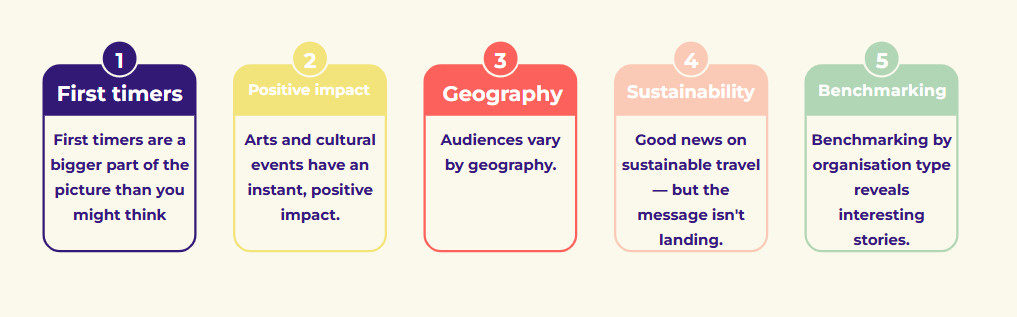
First timers are a bigger part of the picture than you might think
Nearly 1 in 5 audiences (17%) were visiting the organisation who sent them the survey for the first time, rising to 27% in London. Among under-35s, a third were new to the venue.
A few things stood out about first timers:
- Their motivations for attending are very similar to returning audiences. 43% say they are looking for good entertainment, 31% to see a variety of things. There’s not necessarily a need to programme ‘safely’ for new audiences, although we know from other research that a point of connection is important for encouraging them.
- Social media (42%) and word of mouth (19%) are priority methods for reaching them. They aren’t on your email lists yet, and they are less likely to come to your website (20% vs 30% for returners).
- Naturally, they’re far less likely to be coming because they love you as a venue. Only 2% ‘I love the organisation’ as a motivation, compared to 27% of returners. Affinity with you takes time to build.
- Similarly, their Net Promoter Score is 68, below the benchmark of 74. They are less likely to shout about you to other people, despite relying on that same word of mouth themselves.
Arts and cultural events have an instant, positive impact
One of the most encouraging findings is how quickly audiences feel the benefit, even on a first visit:
- 76% of first-timers said the experience helped them escape from everyday life
- 71% said it improved their wellbeing
- 85% felt welcome and included.
The good news is that these benefits are reported even among low-frequency attenders (once a year or less), with 68% reporting a wellbeing boost. Under-35s, the biggest social attenders, are the most likely to say that the experience helped them escape from everyday life (84%) and the most likely to say they felt welcome (91%).
Audiences vary by geography
We compared London with Yorkshire and the North East to test whether there were regional differences, and there were:
- Londoners are less loyal, visiting lots of different venues. 75% attend the arts 6+ times a year (vs 46% in Yorkshire and North East) and 27% were first-time visitors to the venue (vs 15%), suggesting lots of experimentation across organisations. They’re also more drawn to work that challenges and provokes (12% vs 5%).
- Northern audiences are having a better time of it! Yorkshire and the North East returned a higher NPS (79 vs 65), greater likelihood to return (87% vs 77%) and stronger wellbeing and welcome scores.
Good news on sustainable travel — but the message isn’t landing
Audience travel is a major part of an organisation’s carbon footprint, so it’s great to see a shift away from petrol and diesel cars towards public transport and hybrid or electric vehicles.
The challenge is perception: only 15% of audiences strongly agree that the organisation they visit demonstrates a clear commitment to environmental responsibility. There’s brilliant work happening across the sector, but audiences aren’t hearing about it. Find out more about our Talking Sustainability Toolkit.
Benchmarking by type of organisation reveals interesting stories
As the dataset grows, we can now cut it by organisation type:
- Producing houses attract a slightly more culturally confident audience (more likely to enjoy being challenged, more eclectic tastes, more frequent), while receiving houses see three times as many bookers motivated by discounts.
- Classical music audiences posted the highest NPS (80) and the highest wellbeing score (83%) of any group we looked at: they are getting an enormous amount out of their experiences.
Our four key takeaways
- Lean into wellbeing and escapism. The arts has an instant positive impact on audiences – and we could do more as a sector to lean into that messaging. 71% of audiences said the experience improved their wellbeing, 76% that it helped them escape from everyday life. And these stats were just as high for low frequency attenders, younger people and first timers to an organisation. The Net Promoter Score is consistently high. You are all doing such a brilliant job to make audiences feel welcome. We want to think about what more we could do as a sector to lean into that messaging and encourage people to come and have these wonderful experiences.
- Thank your audiences for their sustainability efforts, and find ways to tell them about your own. Your audiences are making changes to be more sustainable – and for some organisations, this is particularly around travel. Our Act Green research shows us that audiences really care whether the organisations they visit are making an effort to be more sustainable and lead the way in this conversation and that they share their values in this area. Can you do anything to highlight that you have noticed these changes and thank your audiences? There are lots more ideas for how to engage with audiences in our Talking Sustainability Toolkit so we hope you will sign up to be a beta tester and have a go.
- Use your data to make the case for your impact. The data we are collecting through the post visit surveys is hugely useful for making a case for the impact you have as an organisation – on individuals and the community around you. As Mark Scott explained in the webinar, Indigo Share data can be used alongside other data to build a rich picture of your audiences and the impact you’re having on them. Use our Indigo Total Insight model – Profile / Behaviour / Attitude / Impact – to think about what else you know about your audiences, how you are gathering that information and how you can weave it together to build a detailed understanding of your audiences and show that to funders, local councillors and any other stakeholders.
- Join Indigo Share and strengthen the Benchmark. We have a huge range of organisations using our Indigo Share surveys, and the more organisations we have, the stronger we make that benchmark. We can also produce more of those other benchmarks, such as by type of organisation or region. It is important to say that Indigo Share can be a comprehensive tool for all your audience insight or a complementary tool alongside other insight you do in your organisation; we have a real range of sizes of organisation who use it and get great value from it. Have a conversation with us if you’re unsure – we’d love to work out how we can help. There is also a 25% discount if you are referred by a current Indigo Share Subscriber, who will also get that discount themselves, so worth thinking about whether there are other organisations you work with who could recommend you or vice versa.